Anyone who deals with fiber will sooner or later ask this exact question: Inulin vs. psyllium husk effect - what really helps more in everyday life? The short answer is not either/or. Both work, but in different ways. And that's exactly why it's worth taking a closer look if you want to smarter solve bloating, irregular digestion, little satiety, or simply insufficient fiber intake.
Inulin vs. Psyllium Husk Effect: The Decisive Difference
Inulin and psyllium husks both belong to the fiber group, but they don't play the same role in the body. Inulin is a soluble, fermentable fiber. This means it serves as food for gut bacteria and is metabolized by them in the large intestine. As a result, inulin can primarily support the gut flora.
Psyllium husks work differently. They bind a lot of water, swell significantly, and form a gel-like mass. This physical effect is particularly relevant for stool consistency, digestive regulation, and also for satiety. So, while inulin acts more strongly on the microbial level, psyllium husks often have a more quickly noticeable effect on everyday digestion.
That's the core of the question. If you want to specifically feed gut bacteria, inulin is interesting. If you are more interested in regularity, bulk, and gentle digestive support, psyllium husks often come out on top.
What Inulin Does in the Gut
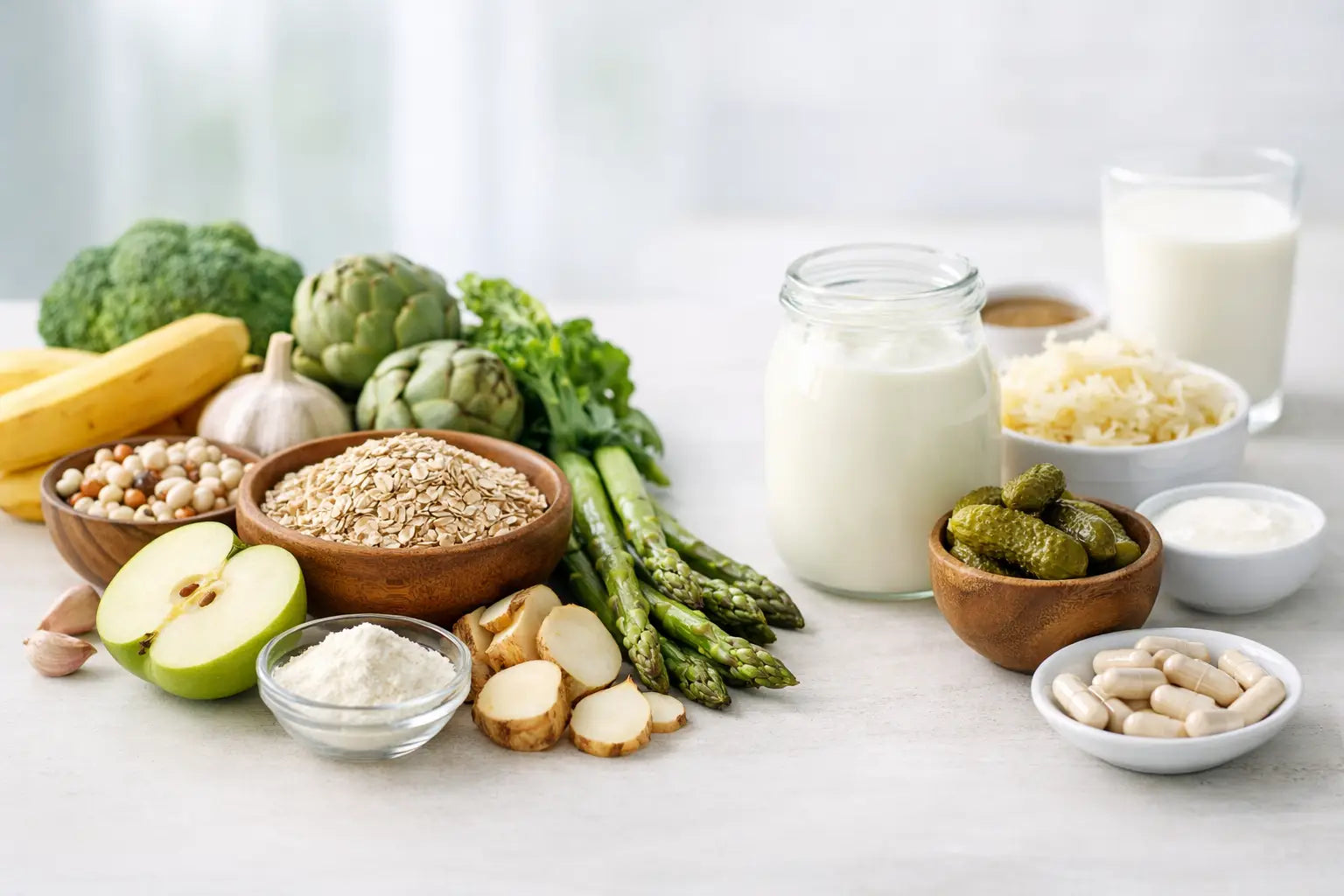
Inulin occurs naturally in chicory, Jerusalem artichokes, and onions, among other things. As a prebiotic fiber, it is often used to promote beneficial gut bacteria. In this context, "prebiotic" means that the human body does not digest the substance, but certain microorganisms in the gut utilize it.
This can be useful because a diverse and well-nourished gut flora is linked to various aspects of health - from digestion and metabolism to immune functions. In addition, short-chain fatty acids are produced during fermentation, which play an important role in the gut.
The catch: This fermentation is not immediately pleasant for everyone. Especially if you have previously eaten a low-fiber diet or tend to have sensitive digestion, inulin can initially increase bloating, pressure, or rumbling. This is not automatically a bad sign, but it shows that more is not always better. The dose and habituation make a big difference here.
What Psyllium Husks Do
Psyllium husks are also soluble fibers, but they are significantly less fermentable than inulin. Their strength lies primarily in binding water. This makes the intestinal contents softer and more voluminous. This can be helpful when digestion is sluggish. At the same time, psyllium husks can also have a stabilizing effect on overly soft stools by binding excess fluid.
It is precisely this balancing effect that makes them suitable for many people in everyday life. They don't just work in one direction. Rather, they help regulate stool consistency. In addition, the swelling gel in the stomach and intestines often leads to greater satiety. Those who experience cravings or quick re-hunger sometimes feel this effect quite directly.
However, fluid is important. Psyllium husks need water to function well and remain tolerable. Those who take them without sufficient fluid intake make life more difficult for themselves.
Which effect is better for constipation?
For constipation, psyllium husks are often the more obvious option. Not because inulin is ineffective, but because psyllium husks can provide better mechanical support through their swelling capacity. They increase stool volume, improve lubricity, and help many people regain more regularity.
Inulin can be a useful supplement, especially if long-term improvement of the gut flora is part of the goal. However, for acute or clearly noticeable sluggishness, it is not always the first candidate. For a sensitive stomach, it can even make the problem subjectively more uncomfortable at first, although it can have long-term benefits.
So, if your main issue is slow digestion, psyllium husks are often the more pragmatic starting point.
What role does the gut flora play?
Here, inulin scores particularly well. As a prebiotic fiber, it can promote the growth of certain beneficial bacteria. This effect is well-studied scientifically and is one of the main reasons why inulin is used in many modern fiber formulations.
While psyllium husks also have positive effects on the gut, they are less pronounced in terms of targeted microbiota feeding. They are more of a quiet regulator than a classic prebiotic. If you specifically want to do something for your gut flora, inulin is often the more exciting choice.
The crucial nuance: Healthy digestion usually requires more than just one goal. A gut flora benefits from fermentable fibers, but everyday life often also benefits from fibers that bind water and improve stool consistency. Therefore, a combination can be more sensible than choosing just one substance.
Inulin vs Psyllium Husk Effect for Bloating and Sensitive Digestion
Those prone to bloating should differentiate. Inulin is effective, but for sensitive digestion, it's not always a gentle introduction. Fermentation can produce gas. Especially in larger quantities, this is a common reason why people prematurely dismiss inulin as intolerable.
Psyllium husks are often better tolerated, provided enough fluid is consumed and the amount is gradually increased. Therefore, for many, they are a good starting point if the stomach reacts quickly. Nevertheless, the same applies here: too much at once can cause a feeling of fullness.
If you are sensitive, a slow build-up is always better than an ambitious initial dose. The gut loves routine, not overstimulation.
What helps better with satiety?
When it comes to satiety, psyllium husks often have the upper hand. By swelling significantly, they increase the volume in the gastrointestinal tract and can thus contribute to meals keeping you fuller for longer. This is particularly interesting for people who want to increase their fiber intake without complicating their daily lives.
Inulin can also indirectly affect appetite regulation and metabolism, but this effect is usually less immediately noticeable. Those looking for a fiber that is more noticeable in everyday life often think of psyllium husks first.
Why the best solution often doesn't consist of just one fiber
The question of inulin vs. psyllium husk effect sounds like a duel. In practice, it's more of a division of labor. One fiber can specifically nourish the microbiota, another can mechanically support digestion, and yet another can improve mouthfeel or everyday usability.
This is precisely why modern formulations often rely on fiber blends. The goal is not a single star ingredient, but a better overall profile of tolerability, gut flora support, satiety, and easy integration into daily routines. For many people, this is the smartest solution, because everyday life rarely has only one digestive issue.
Innerpure also therefore uses an approach that does not consider fibers in isolation, but as part of a daily supply gap that should be closed as uncomplicated as possible.
What you should look for when choosing
When choosing between inulin and psyllium husks, a simple counter-question helps: What is currently your main goal? If your primary concern is prebiotic effect and gut flora, inulin is particularly relevant. If your concern is digestive regulation, stool consistency, and satiety, psyllium husks are often closer to your needs.
Beyond that, tolerability matters. People with sensitive stomachs often benefit from starting with small amounts and not introducing several new factors at once. Everyday applicability is also crucial. Fiber does little good if you lose it from your routine after three days.
Taste, solubility, and flexibility in drinks or meals are therefore not superficial, but practically relevant. The best supplement is not the one with the loudest ingredient, but the one you actually use consistently.
How to use fiber effectively in everyday life
Whether it's inulin, psyllium husks, or a combination: start slowly. The most common mistake is not the wrong fiber, but the wrong amount at the wrong time. Those who jump directly from very little fiber to high doses often provoke exactly the complaints that should actually be improved.
A gradual increase over several days or weeks is helpful. In parallel, you should drink enough fluids and not see fiber as an isolated trick. Exercise, meal rhythm, and general dietary quality also play a role.
If you are taking medication or have known gastrointestinal diseases, individual medical consultation is advisable. Fiber is not a minor matter - in a positive sense. It noticeably affects digestion and metabolism, and that is precisely why a conscious approach is worthwhile.
In the end, you don't have to find the one perfect fiber. Often, it's enough to choose the one that suits your gut, your everyday life, and your routine - and incorporate it consistently and well.