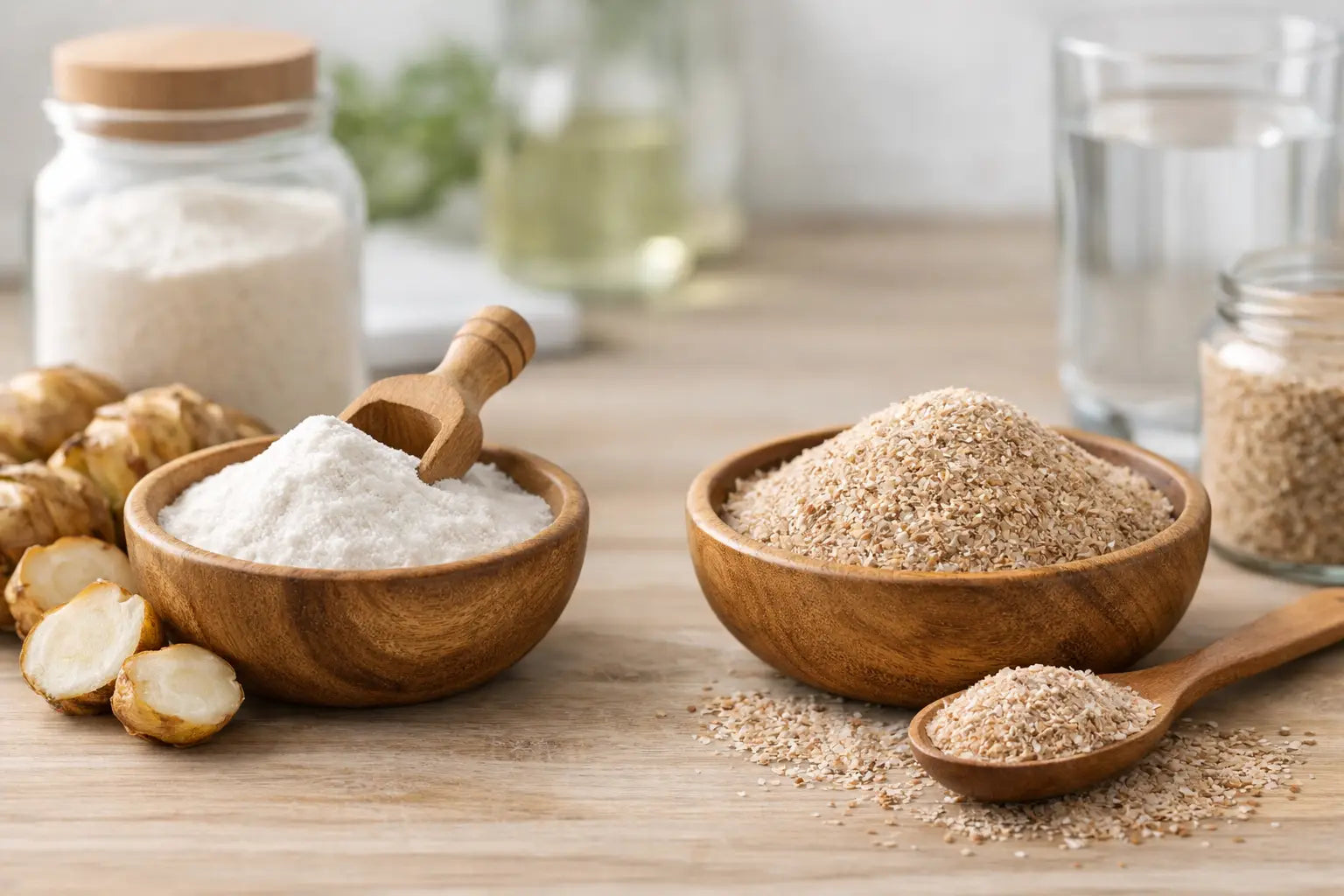
Anyone who has ever tried to meet the recommended daily fiber intake quickly realizes: It often fails not due to lack of knowledge, but due to everyday life. This is precisely why a fiber supplement comparison makes sense – not every product suits every goal, every digestion, and every routine.
What a good Fiber Supplement Comparison really needs to show
Many comparisons stay on the surface. They sort by price per can, perhaps by taste or packaging. This is not enough for a good decision. What matters is which fibers are included, how well they are tolerated, how easily they can be integrated into daily life, and whether the dosage is even realistic.
Fiber is not just fiber. Soluble and insoluble varieties behave differently in the body. Soluble fibers can bind water, influence stool consistency, support satiety, and serve as food for certain gut bacteria. Insoluble fibers tend to increase stool volume and promote passage. Both can be useful – but depending on the product, the focus is clearly different.
For supplements, it is particularly relevant whether a product is intended to specifically close the daily supply gap or is rather intended as a selective digestive aid. This is a difference that is often only apparent at second glance.
Types of Fiber Compared
Psyllium Husks
Psyllium husks are probably the best-known category. They swell significantly, can regulate digestion, and are often used for sluggish digestion or irregular bowel movements. The big advantage is their known effect. The disadvantage: Many people find the texture sandy or gel-like, and this precisely makes daily use difficult.
Those who are sensitive to strong swelling agents or dislike thick drinks rarely stick with it long-term. For a consistent routine, therefore, not only the effect but also the mouthfeel is a real factor.
Inulin and other prebiotic fibers
Inulin, oligofructose, or acacia fiber are often used when the focus is on gut microbiome, regular supply, and good miscibility. These soluble fibers are often finer, easier to stir into water, coffee, yogurt, or smoothies, and fit better into a modern daily routine.
However, here too: More is not automatically better. Especially prebiotic fibers can initially lead to bloating if the dose is too high or if there is no habituation. A good product therefore relies not only on one raw material but on a sensible composition and an everyday-suitable starting recommendation.
Resistant Dextrins and Corn Fibers
These forms are usually very neutral in taste and technologically pleasant – they often dissolve well and hardly change the consistency. This makes them attractive for people who want to incorporate fiber into their routine as discreetly as possible. They are particularly interesting when the goal is not acute digestive aid, but a consistent daily supplement.
The catch: Not every product clearly communicates the quantity of these fibers and what contribution a serving actually makes. This is precisely why it is worth looking at the nutritional information rather than just the marketing terms on the front.
Powders, Capsules, or Gummies?
A fiber supplement comparison should always include the dosage form. Because what sounds good in theory must work practically every day.
Powder is usually the most sensible form for fiber. The simple reason: relevant amounts need volume. If you want to consume several grams of fiber per serving, powder usually gets you further than capsules or gummies. In addition, powder can be dosed more flexibly and integrated more easily into existing routines – into water, porridge, or a shake.
Capsules seem more convenient at first glance but quickly reach their limits. To get a relevant amount of fiber, often many capsules are needed. This is expensive, impractical, and for many, not a long-term solution.
Gummies are more lifestyle than actual supply. They can seem nice as an introduction but often contain sugar, additives, or only small amounts of fiber. If you really want to close your fiber gap, you should look particularly critically here.
What to look for in a comparison
Not every formula that looks good is also well-designed. Four points make the difference in practice.
First: the amount of fiber per daily serving. If a product only provides 2 or 3 grams, that can be a start – but rarely a relevant contribution if daily intake is significantly below requirements.
Second: tolerability. A highly dosed product is of little use if it's back in the cupboard after three days. Good supplements are formulated so that they can be introduced even with sensitive digestion.
Third: mixability and taste neutrality. Sounds trivial, but is often the point at which routines fail. If a powder clumps, is strongly sweet, or changes every meal, it rarely becomes part of everyday life.
Fourth: transparency. Which fibers are included? What is the proportion per serving? Is there a clear consumption recommendation, including advice on gradual increase and sufficient fluid intake? Reputable products make it easy to understand this.
For whom which supplement is useful
If you primarily want to improve your daily fiber intake in everyday life, taste-neutral powders with soluble fibers are usually the most elegant solution. They fit into drinks and meals without you having to change your entire eating style.
If you tend to have irregular digestion and are specifically looking for a swelling agent, psyllium husks can be useful. However, it is especially important to start slowly and drink enough.
If you are sensitive, a product with a moderate dosage and a well-tolerated fiber combination is worthwhile. The best approach is rarely to maximize, but to be consistently sufficient. Gut health benefits more from regularity than from ambitious short-term starts.
Common mistakes in fiber supplement comparison
The most common mistake is to only look at the highest gram count. More fiber is not automatically better if tolerability, consistency, or application are not right. A product that promises 15 grams but is never consistently used is worth less than one with 6 to 8 grams that is actually taken every day.
A second mistake is the expectation of immediate effects. Fiber is not a quick fix. The body often needs several days to weeks to adapt to a higher intake. Especially with the microbiome, daily repetition counts more than the short-term effect.
Also important: Supplements do not replace an overall low-fiber diet. They can close a gap, but they cannot compensate for every vegetable, every legume, and every whole grain product. They work best as a smart supplement, not as an excuse.
What a modern fiber product should deliver today
The demands have changed. In the past, it was enough for a product to somehow work. Today, a supplement must be evidence-based, well-tolerated, taste-neutral, and suitable for everyday use. It should not be disruptive, but seamlessly integrate.
This is where functional product development separates itself from pure label logic. A well-thought-out combination of several soluble fibers can be more sensible than focusing on just one ingredient. Because different fibers bring different properties – in terms of fermentation, satiety, texture, and tolerability.
For many people, therefore, the best choice is not the most aggressive product, but the one that can be used daily without friction. A clearly formulated powder that fits into coffee, water, or breakfast is often closer to genuine health behavior than any spectacular single ingredient. Brands like Innerpure rely precisely on this logic: closing the supply gap without complicating everyday life.
Fiber Supplement Comparison: How to make a good decision
When comparing products, don't ask first: Which is the strongest? Rather ask: Which one will I actually take every day? That is the more relevant question.
Look for a sensible amount of fiber, clear labeling, good solubility, and a formulation that suits your digestive type. If you are sensitive, start low. If you primarily want convenience, a neutral powder is usually more practical than capsules or gummies. And if a product only convinces with loud health claims but provides no clear information, caution is advised.
The best solution is rarely the most striking. It is the one you naturally use in the morning or at noon until a supplement has become a routine. That's where the difference between well-intentioned and truly effective begins.