If you only think of psyllium husks when you hear "digestion", you're often missing the bigger picture. The question of which fiber is good cannot be answered with a single powder, a trendy ingredient, or a chart. What matters is the type of fiber you consume, how well you tolerate it, and whether it realistically fits into your daily life.
This is where it gets interesting: Fiber isn't just "good for digestion." Depending on its structure and solubility, it influences satiety, bowel regulation, blood sugar, the microbiome, and even how consistent your energy levels feel throughout the day. Those who understand this make significantly better decisions than with the old approach of "just eat more whole grains."
Which fibers are good - and why?
It's generally helpful to distinguish between soluble and insoluble fibers. Both have their place, but they work differently.
Soluble fibers bind water and sometimes form gel-like structures. These include, for example, inulin, resistant dextrins, beta-glucans, acacia fiber, or partially psyllium husks. They can gently regulate digestion, support satiety, and serve as nutrients for certain gut bacteria. Many people particularly benefit from this category in their daily lives because it specifically closes the fiber gap without having to completely overhaul every meal.
Insoluble fibers are primarily found in whole-grain products, bran, nuts, seeds, and vegetables. They increase stool volume and can stimulate bowel activity. This is beneficial, but not automatically the best first solution for every person. Those prone to bloating, sensitive digestion, or stress-related complaints do not always ideally tolerate large amounts of coarse, insoluble fiber.
The short answer to the question of which fibers are good: usually a sensible mix. Not the maximum amount of one type, but the right combination for your goal and your tolerance.
Not every good fiber suits every goal
Those primarily looking to make their digestion more regular often respond well to water-binding and gently regulating fibers. Psyllium husks are well-known here, but acacia fiber or resistant dextrins can also be more suitable for everyday use, depending on the product and dosage, because they are often easier to integrate into drinks or meals.
If the focus is more on satiety and cravings, soluble fibers are particularly interesting. They can slow down gastric emptying and thus help meals last longer. This won't magically make a snack impulse disappear, but it can make a noticeable difference, especially at breakfast and lunch.
Fermentable fibers are relevant for the gut flora. These include inulin or certain oligofructans. They promote the growth of beneficial bacteria, which can be positive. At the same time, the classic "it depends" applies here: highly fermentable fibers, in particular, can initially lead to more gas formation in some people. So, "good for the microbiome" doesn't automatically mean comfortable at every dose.
If you are sensitive, gentle is often wiser than maximally prebiotic. The best fiber source is the one you tolerate regularly and therefore truly use daily.
An overview of the best fibers
There isn't one single winner, but some types have proven particularly effective.
Psyllium husks
Psyllium husks bind a lot of water and are classically used for sluggish digestion or irregular stools. They can be very effective, but require enough liquid and precise dosing. Too much too quickly can easily lead to bloating or abdominal pressure.
Acacia fiber
Acacia fiber is considered rather mild and is well tolerated by many people. It is soluble, easy to integrate into routines, and often a pleasant introduction for sensitive individuals. Those who have avoided fiber in the past often get along better with this type than with very coarse sources.
Inulin
Inulin is prebiotic and can positively influence the gut flora. At the same time, it is a good example of how effective doesn't always automatically mean uncomplicated. For sensitive digestion, inulin can cause bloating more quickly, especially in higher amounts.
Resistant dextrins
Resistant dextrins are soluble fibers that can be used neutrally in taste and without complications. This is precisely what makes them attractive for everyday use: they fit into water, coffee, yogurt, or smoothies without every application becoming a small science.
Beta-glucans
Beta-glucans from oats or barley are particularly interesting if you also pay attention to satiety and metabolism in addition to digestion. They have a gel-forming effect and are therefore often mentioned in the context of blood sugar and cholesterol management.
How to recognize good fibers
A good fiber is not only beneficial on paper, but in your life. This sounds simple, but is often overlooked.
Firstly, the source should fit your daily routine. If a product only works if you integrate it into an elaborate morning ritual with a blender, meal prep, and timing, the likelihood of true regularity is rather low. Practicability is not a nice extra, but half the battle.
Secondly, tolerability counts. Many people make the mistake of immediately dosing high. The gut reacts to change. More fiber can be beneficial at first, but too much at once quickly leads to bloating, pressure, or an uncomfortable feeling of fullness. A gradual build-up over several days or weeks is better.
Thirdly, the combination is relevant. Individual fibers can have targeted effects, but mixtures of several soluble sources are often more balanced. They combine various functional benefits and are in many cases more pleasant than high doses of a single component. This is precisely why modern formulations often rely not on single products, but on well-thought-out blends.
Food or supplement - which is better?
The honest answer is: both can be useful.
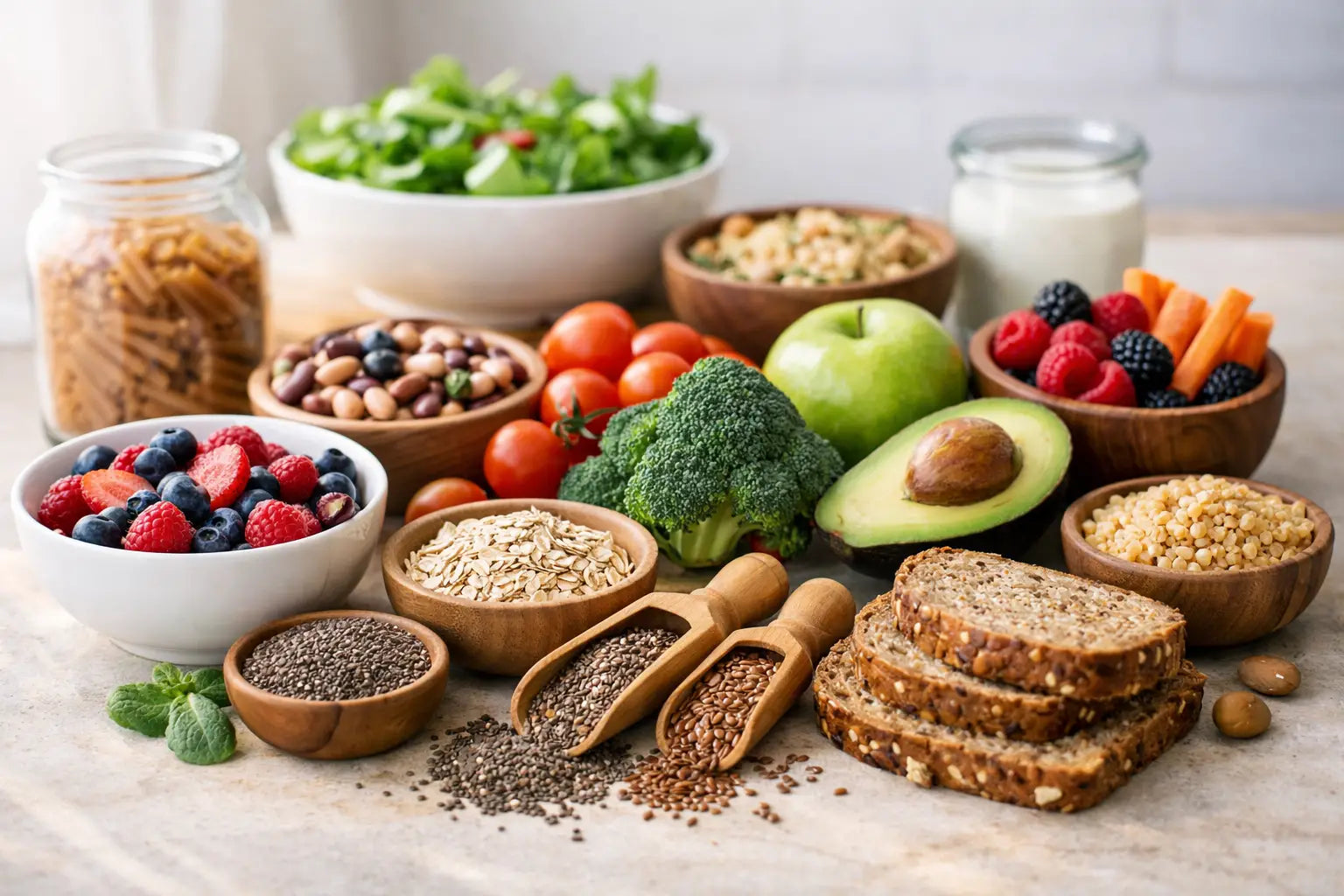
Fiber-rich foods remain the basis. Vegetables, legumes, oatmeal, berries, nuts, seeds, and whole grains not only provide fiber but also micronutrients and phytochemicals. If your diet is generally very poor in plant-based foods, a supplement alone will not solve the entire problem.
Nevertheless, daily life often fails not due to knowledge, but due to consistency. Between meetings, commuting, training, and dinner out, many people simply don't get the recommended amount. This is where a well-formulated fiber product can be useful - not as a substitute for nutrition, but as a smart supplement that realistically closes your supply gap.
If a supplement is tasteless, easy to stir in, and combines several soluble fibers, the chance of it becoming a daily routine increases. And routine is more important than perfection when it comes to fiber.
Which fibers are good for sensitive digestion?
For sensitive digestion, a cautious start is advisable. Very coarse bran products or high amounts of highly fermentable fibers are not always the best first choice. Mild soluble fibers that can be gradually increased in dose and do not abruptly overwhelm the gut are often better tolerated.
Timing is also important. Even a good fiber can have an unpleasant effect directly with a very large, fatty, or hastily eaten meal. Many people find it better to start with small amounts, drink enough, and incorporate the intake consistently throughout the day.
If you already have known gastrointestinal complaints or react to certain FODMAP-rich substances, differentiation is particularly important. Then the question is not "are fibers good?", but "which fibers are actually useful for me right now?"
How to integrate fiber without overhauling your daily routine
The best strategy is rarely radical. A fiber-richer breakfast, a portion of legumes a few times a week, and a simple daily supplement often achieve more than a short burst of motivation followed by a complete cessation.
Practically, this means: start low, drink enough, and give your gut a few days to adjust. Observe not only whether you have bloating, but also how regular your digestion becomes, how full you stay after meals, and whether your stomach feels calmer overall.
Those who want it particularly simple rely on a fixed ritual. A spoonful in a smoothie, yogurt, or water in the morning is often more realistic than the plan to perfectly optimize every meal starting tomorrow. This is also the appeal of modern solutions like a clearly formulated Fiber Blend: less complexity, more daily implementation.
Ultimately, good fibers are not those that are most loudly advertised online. Good are the fibers that suit your body, your goal, and your daily life - and that you use so naturally that it becomes a true routine.