Salad for lunch, an apple in between, and some vegetables for dinner – yet fiber intake often remains significantly below what's good for the body. This is precisely why the topic of simply increasing fiber in everyday life is so relevant: not because you suddenly have to eat perfectly, but because small, consistent adjustments can make a noticeable difference.
Fiber is not a niche topic for people who follow a particularly strict diet. It's one of the basics of a smart routine. A high-fiber diet can support digestion, keep you feeling full longer, and help maintain more stable blood sugar and energy levels throughout the day. This sounds technical, but it's very practical: less urge to snack, more regularity, and often a better gut feeling.
Why there's often a lack of fiber in everyday life
The recommendation for adults is around 30 grams of fiber per day. In reality, many fall significantly short. This rarely has to do with a lack of knowledge. Usually, daily life is simply built on convenience – quick breakfast, lunch on the go, something light in the evening, or a snack instead of a full meal.
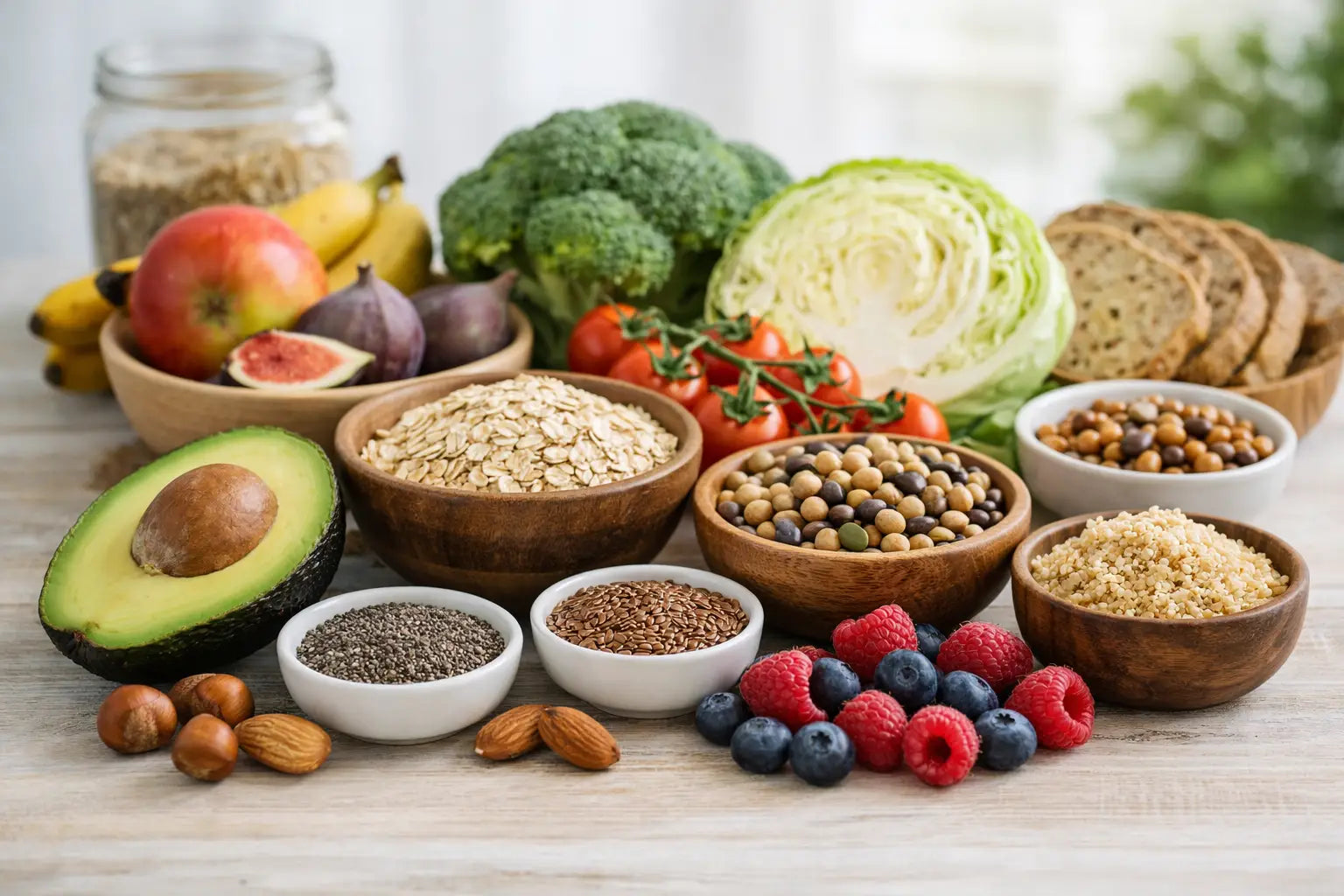
Added to this is a common misconception: many associate fiber primarily with coarse whole grains or large portions of vegetables. Both can help, but that's not the whole story. Legumes, nuts, seeds, berries, oats, and soluble fiber also play an important role. Those who rely only on individual "healthy" foods but don't develop a routine often still fail to close the nutritional gap.
Simply increase fiber in everyday life – without dietary stress
The most sensible approach is not a radical restart, but a system that fits your daily routine. Fiber doesn't work well because you occasionally eat it in very large quantities. Daily regularity is key.
In the morning, the easiest lever is often breakfast. A croissant or toast that provides little satiety is quickly eaten but offers hardly any fiber. Just switching to oatmeal, overnight oats, or plain yogurt with berries, chia seeds, and nuts makes a significant difference. If you have little time in the morning, friction is key: anything that's ready in two minutes has a better chance of becoming a routine.
At lunchtime, it's worth taking a different look at your plate. Not just the question "What am I eating?", but "What is the base made of?" makes a big difference. White rice, white pasta, or a small sandwich are often quickly digested and only satiate for a short time. More fiber is created when you swap out or supplement the base – for example, with whole-grain alternatives, lentil pasta, beans, chickpeas, or extra vegetables. It doesn't have to become a clean-eating project. Even a wrap with hummus and vegetables instead of just cheese and lettuce is an upgrade.
In the evening, the principle often works best by adding rather than omitting. If you love pasta, you don't have to cut it out. Often, it's enough to enrich a vegetable sauce with lentils, add seeds to a salad, or include legumes in soup. This increases the fiber content without making the meal more complicated.
The best levers are often unspectacular
Many people search for the one perfect solution. In everyday life, however, small standards win. If you add just one high-fiber component to each of your three meals a day, it quickly adds up.
A few typical examples: oats instead of highly processed breakfast cereal, berries instead of pure fruit juice, whole-wheat bread instead of white pastries, nuts instead of sweet snacks, roasted vegetables instead of a side dish without structure. This sounds simple, but that's precisely the point. Health rarely fails due to a lack of theory, but rather due to overly complicated plans.
Drinks are also often overlooked. Smoothies seem healthy, but depending on how they're prepared, they provide less satiating structure than whole fruit. If you want to specifically increase fiber, you're usually better off with real ingredients to chew on or with neutral-tasting fiber solutions that can be easily integrated into drinks and meals.
Soluble and insoluble fiber – why the mix matters
Not all fibers work the same way. Insoluble fibers, for example, are more common in whole-grain products or vegetables and contribute to bulk in the intestines. Soluble fibers can bind water and are fermented in the intestines. This is exciting because they can also influence the microbiome and aspects like satiety and metabolism.
For everyday life, this doesn't mean you have to memorize foods in categories. The mix is more relevant. If you only eat dry whole grains but otherwise have little variety, you won't automatically get the best out of it. A spectrum of oats, fruits, vegetables, legumes, seeds, and – as needed – a well-tolerated supplement is more sensible.
Especially with sensitive digestion, however: more is not always immediately better. If intake has been very low and you increase it sharply overnight, bloating or a feeling of fullness may occur. In that case, the concept isn't wrong, but the pace is too fast.
How to easily and tolerably increase fiber in everyday life
The smart way is a gradual adjustment over one to two weeks. Don't increase everything at once; start with one meal. For example, breakfast first, then lunch, then snacks. This way, you'll notice more quickly what suits you and what was perhaps too much.
Water is part of it. Fiber needs fluid to perform its function well. Those who eat more fiber but still drink too little often feel heavy rather than better. Here, too, it's not about perfection, but about a coherent overall picture.
If you rarely eat legumes, small amounts are often more sensible than a large bowl of beans on the first day. The same applies to seeds or highly fortified muesli. Tolerance is individual. Good routines respect this instead of ignoring it.
When a supplement can be useful
Theoretically, your needs can be met through food. Practically, this is not always consistently possible. Workdays, travel, appetite, appointments, or a sensitive stomach make perfect nutrition unreliable. This is where a neutral-tasting fiber supplement can be useful – not as a substitute for real food, but as a pragmatic addition.
The quality of the formulation is important. Not every solution fits every daily routine. Some products are gritty, significantly change consistency, or are difficult to integrate. For a daily routine, it's therefore crucial whether a product easily fits into water, coffee, yogurt, or meals, and whether it's well-tolerated.
A modern fiber routine doesn't feel like a health project. It works because it requires little effort. That's why many health-conscious people rely on solutions that fit into any drink and any meal, elegantly closing the fiber gap instead of making the day even more complex.
Common mistakes when increasing fiber
The first mistake is all-or-nothing thinking. Anyone who starts Monday with flaxseeds, beans, whole-wheat bread, raw vegetables, and two new supplements often stops again by Wednesday. Not due to a lack of discipline, but because the routine wasn't suitable for everyday life.
The second mistake is overestimating individual foods. A small salad or a smoothie doesn't automatically make your diet high in fiber. The total amount over the day is crucial.
The third mistake is confusing satiety with heaviness. Fiber should not be burdensome, but rather provide sensible satiety. If a change continuously feels uncomfortable, it's worth looking at the quantity, type of fiber, and drinking habits.
A routine that truly sticks
If you want to simply increase fiber in everyday life, you don't need a perfect meal plan. What counts is a repeatable basic structure. A high-fiber breakfast. A smart lunch swap. A snack with substance. And for days when everyday life gets in the way, a simple supplement that works without taste, effort, or complicated preparation.
That's exactly the difference between good intentions and actual provision. It's not the spectacular single measure that gets you further, but the daily ritual that endures even on stressful days. When health becomes easily integrated, it no longer feels like an additional task – but like an upgrade that moves with you.