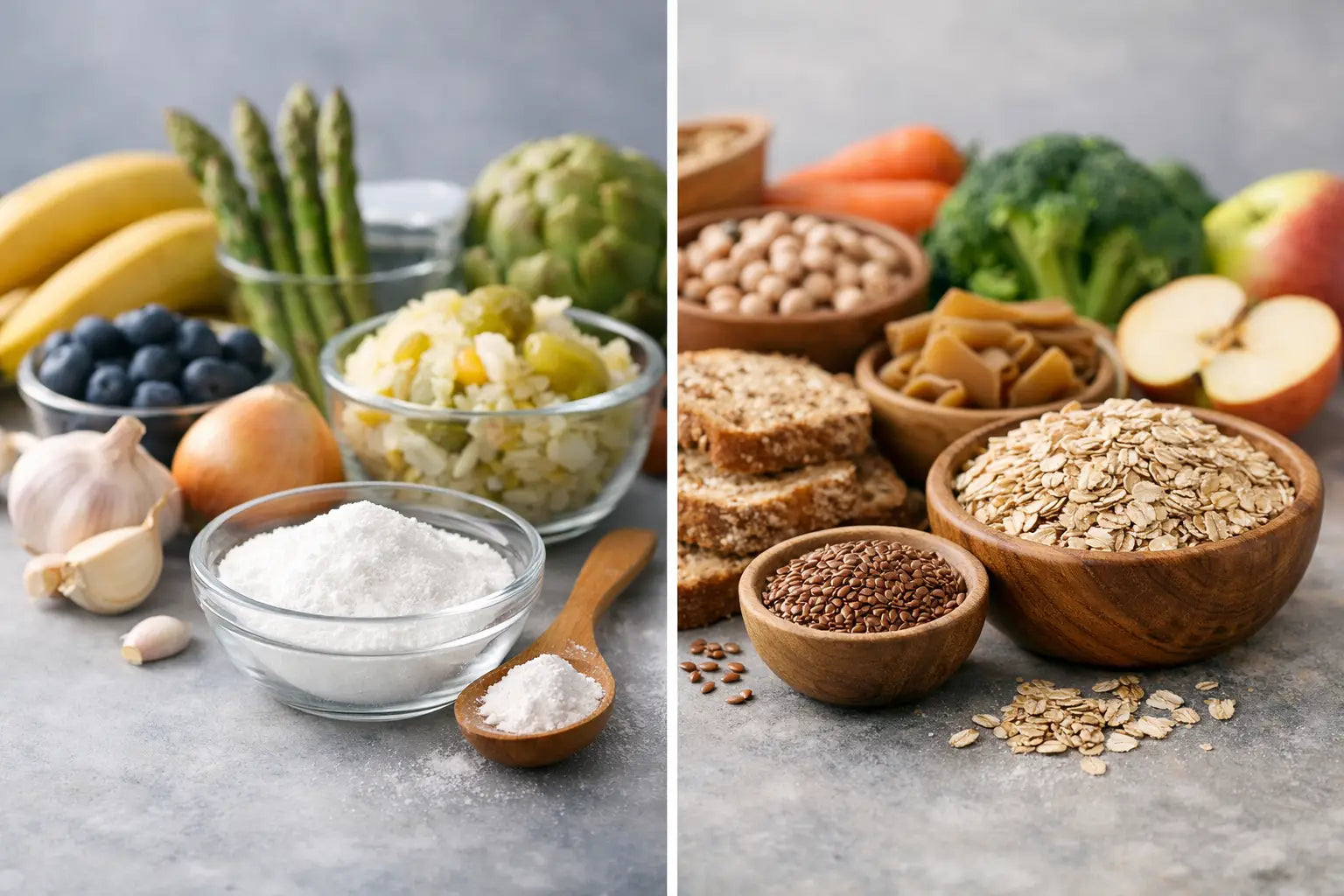
When your stomach feels heavy, bowel movements are absent, and even coffee doesn't move things, digestion suddenly becomes an everyday topic. This is precisely where it can be beneficial to relieve constipation with soluble fiber – not as a quick fix, but as stable support for a calmer, more regular bowel routine.
Why soluble fiber is often useful for constipation
Constipation has many faces. Sometimes stool is hard and dry, sometimes bowel movements are infrequent, sometimes emptying feels incomplete. This is often accompanied by bloating, a feeling of pressure, and the sense that the bowel just isn't getting going properly.
Soluble fiber can help here because it binds water and forms a gel-like structure in the intestine. This can soften the stool and facilitate its passage through the bowel. At the same time, some soluble fiber serves as food for intestinal bacteria. This is relevant because a well-nourished microbiome is linked to healthy digestion, more stable stool consistency, and overall better bowel function.
However, the distinction from insoluble fiber is important. While wheat bran and other coarse fibers primarily provide bulk, soluble fiber often works more gently. People with sensitive stomachs often benefit more from this. Those who are prone to bloating, irritable bowel symptoms, or an uncomfortable feeling of fullness often tolerate a cleverly dosed source of soluble fiber better than large amounts of coarse raw food.
Relieving constipation with soluble fiber - what exactly works?
Not all fiber behaves the same way. This is one reason why some people respond well to one product and hardly at all to another.
Psyllium husks are among the best-known soluble fibers for constipation. They swell significantly, bind water, and can thus improve stool consistency. For many, they are a good starting point because their effect is mechanically understandable and they can be easily integrated into a daily routine.
Partially hydrolyzed guar gum is also considered a well-tolerated option. It is soluble, relatively mild, and often better tolerated than fibers that ferment rapidly and strongly. Especially for people who want support but are sensitive to bloating, this can be interesting.
Inulin and oligofructose have more of a prebiotic focus. They promote certain beneficial intestinal bacteria and can thereby improve the intestinal environment in the long term. At the same time, they are not ideal for everyone, especially not in high doses. Sensitive individuals may experience bloating or rumbling more quickly. So, it depends on the amount, the combination, and individual tolerance.
Precisely for this reason, mixtures of several soluble fibers are often more sensible than high amounts of a single substance. They can combine various mechanisms – water binding, gentle bulk formation, and microbiome support – without unnecessarily overtaxing the bowel.
What you can realistically expect
Soluble fiber is not an aggressive laxative. This is an advantage, but also something to be aware of. The effect is often gentler and builds up over several days. Those who expect immediate results after one portion will likely be disappointed.
More realistic is: The stool gradually becomes softer, emptying becomes more comfortable, and regularity improves. Some feel a difference after just a few days, others only after one to two weeks. This depends on the starting situation – including diet, fluid intake, exercise, stress, cycle, medications, and intestinal sensitivity.
If constipation has persisted for weeks, is very severe, or suddenly worsens significantly, a routine alone is not always sufficient. In such cases, the cause should be medically clarified. Fiber is useful, but not the answer to every digestive problem.
How to start without overwhelming your stomach
The most common mistake is not too little motivation, but too much at once. Those who suddenly supplement large amounts of fiber often produce exactly what nobody wants: more pressure, more bloating, more discomfort.
A slow start is better. Begin with a small amount and gradually increase over several days. This allows the bowel to adapt. At the same time, fluid intake should keep pace. Soluble fiber needs water to work effectively. Taking it dry or with too little fluid will make it harder for the bowel, rather than easier.
The timing can also make a difference. Some do well with it in their morning drink, others stir their fiber into yogurt, porridge, or a smoothie. What matters most is not the perfect time, but regularity. Digestion rarely benefits from activism, but almost always from routine.
Another point: If you are very constipated right now and your stomach is severely distended, even a good fiber source can initially feel uncomfortable. In this case, it's worth dosing particularly carefully and simultaneously paying attention to simple basics – drinking, exercise, warm meals, and a toilet routine.
What is often underestimated in everyday life
Many people search for the one active ingredient, even though the problem usually arises from several small factors. Office life, prolonged sitting, inadequate fluid intake, eating between meetings, a protein-focused diet without a vegetable base, and complete exhaustion in the evening – this is a typical setup for sluggish digestion.
Soluble fiber can cleverly close this gap, especially when the daily diet is intended to be healthy but practically remains too low in fiber. A salad for lunch sounds good, but often provides less than you think. Then there are days with travel, restaurants, little time, or a lot of stress. Especially then, a constant, taste-neutral supplement is more suitable for everyday life than the resolution to eat perfectly from tomorrow on.
Nevertheless, supplements do not replace a basic routine. If you want to support your gut, several small levers work together. Sufficient hydration, daily exercise, and fixed mealtimes usually make the effect of soluble fiber significantly more noticeable.
When soluble fiber is not the best first solution
There are situations where caution is advisable. In cases of sudden constipation, severe pain, blood in the stool, unexplained weight loss, or persistent symptoms, a medical evaluation should clarify the underlying cause. Also, with known bowel diseases or after surgery, it is sensible to discuss any changes with a specialist.
Not everyone reacts equally well to every type of fiber. Those prone to irritable bowel syndrome with bloating should pay particular attention to which soluble fibers are used. Prebiotic fibers can be very beneficial, but in sensitive individuals, they may initially exacerbate symptoms. In such cases, a milder combination is often the better choice.
Medications also play a role. Iron supplements, certain painkillers, or some dietary supplements can promote constipation. In these cases, the best strategy is often not just more fiber, but a look at the overall picture.
The role of routine in relaxed digestion
The gut likes reliability. This may sound unspectacular, but it is one of the most important points of all. If fiber intake is sometimes high, sometimes non-existent, if fluid intake fluctuates daily, and meals are irregular, digestion often remains equally irregular.
A good routine doesn't have to be complicated. A glass of water after waking up, a fiber-rich start to the day, movement between appointments, and a fixed time for supplementation are often enough to bring noticeably more consistency. This is also where the strength of modern fiber products lies: they fit into drinks and meals without making everyday life more complicated.
Innerpure focuses precisely on this principle - scientifically sound fiber supply that can be easily integrated into daily rituals. This is not a detail, but often the difference between a good idea and a habit that truly sticks.
Relieving constipation with soluble fiber - without pressure for perfection
Digestion is not a project that can be optimized in 24 hours. It reacts to sleep, stress, nutrition, hormones, and movement. Therefore, there is no one-size-fits-all solution that works the same for everyone.
What often works is a pragmatic approach: choose a well-tolerated source of soluble fiber, start low, stay consistent, and give the gut a little time. Those who also drink enough and move their body regularly create the conditions under which fiber can do its job well in the first place.
The good news is that small changes often achieve more here than radical plans. Don't eat perfectly. Don't change everything at once. Instead, incorporate a simple, reliable support every day that noticeably relieves your stomach and fits your routine.
When digestion feels lighter again, it is rarely a coincidence. Usually, it is the result of a routine that finally works with the body instead of against it.