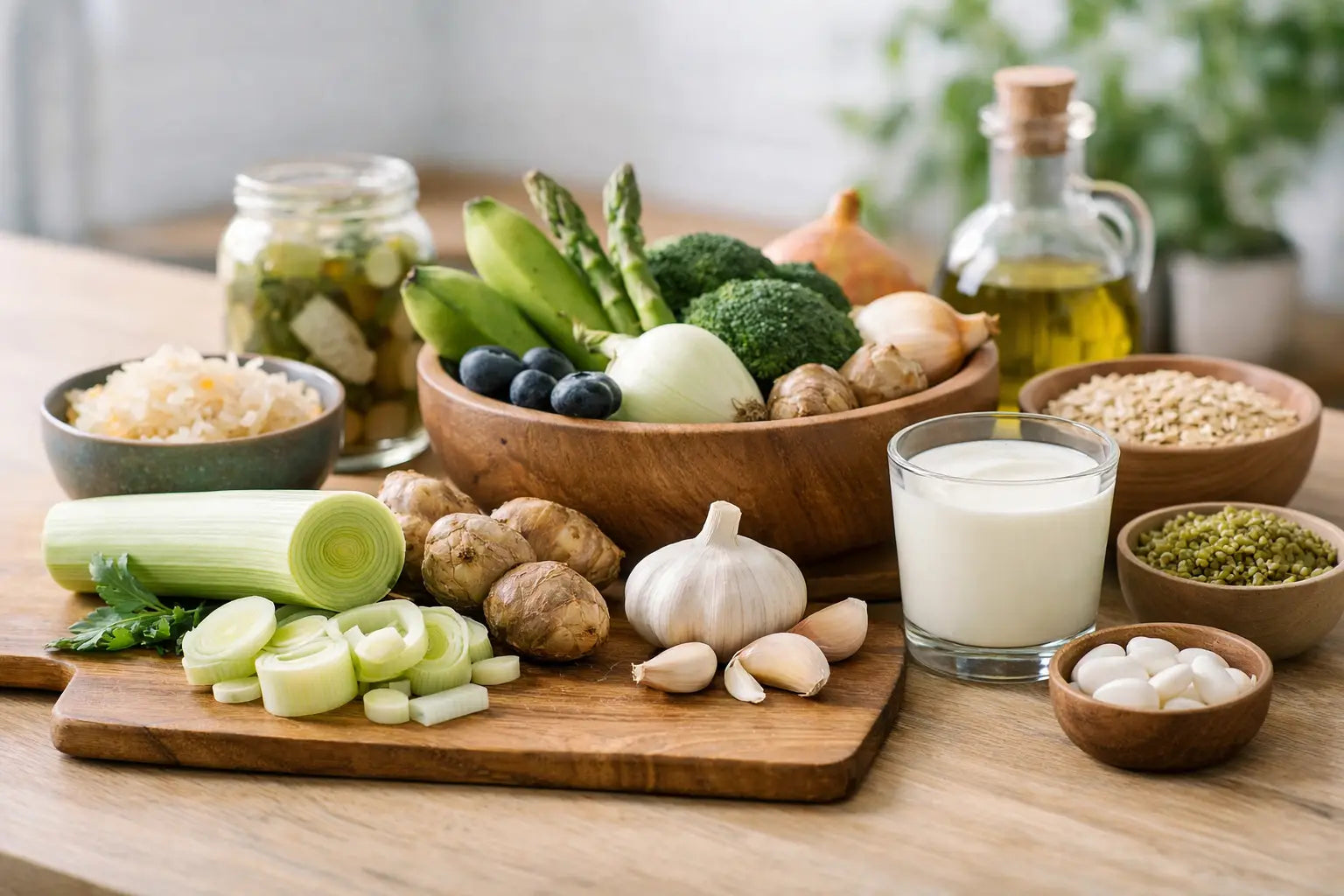
Deciding to choose a gut health supplement is a sensible first step. However, what matters most is not the most eye-catching packaging or the loudest promise, but rather a formula that meaningfully complements your daily diet and feels good in the long run. Because your gut rarely benefits from short-term extremes. What counts is a supply that you reliably integrate into your daily life.
Especially with fiber, there is often a gap: The German Nutrition Society recommends at least 30 grams per day for adults. Many people do not reach this value in their daily lives - despite good intentions, smoothies, and balanced meals. A suitable supplement can close this gap. However, it does not replace the variety on your plate, but specifically complements it.
Choosing a Gut Health Supplement: Not Every Ingredient Serves the Same Purpose
The term "gut supplement" encompasses a wide variety of products. Some contain probiotics, i.e., live microorganisms. Others focus on prebiotics, which can serve as food for certain gut bacteria. Still others provide fiber, vitamins, plant compounds, or enzymes. These are not interchangeable.
If your goal is a reliably higher fiber intake, fiber should be clearly identifiable as the main ingredient. For probiotics, it's worth taking a closer look at the specific bacterial strain name and the quantity used. General statements like "good for the gut" are not very helpful in making a choice, because the effect and tolerability always depend on the ingredients, dosage, and individual starting point.
A good product therefore transparently states what it contains, how much is delivered per serving, and what the individual components are intended for. Hidden mixtures without quantity specifications make a sound comparison unnecessarily difficult.
1. Pay Attention to the Type of Fiber
Fibers are not all the same. Insoluble fibers, such as those found in whole grain products, primarily increase stool volume. Soluble fibers bind water, are partially fermented in the large intestine, and can serve as a substrate for the gut flora. Both groups are part of a balanced diet.
For a daily supplement, soluble, easily dosed fibers are often particularly practical. They can be stirred into water, coffee, yogurt, or meals, making them suitable for busy workdays. A combination of different soluble fibers can be useful, as they are not all processed identically in the gut.
At the same time: more variety in a formula is not automatically better. For a sensitive stomach, a complex mixture or a high proportion of highly fermentable fibers can initially lead to bloating. In such cases, a moderate, clearly declared recipe is often the better starting point.
Highly fermentable is not ideal for everyone
Inulin and certain fructooligosaccharides are often used as prebiotic fibers. They can be suitable for many people, but are relatively highly fermentable. Those who tend to suffer from irritable bowel symptoms, pronounced gas formation, or a low FODMAP tolerance may react more sensitively to them.
This does not mean that these ingredients are inherently bad. It only means that your daily life and your tolerability are more important than an ingredient trend. A supplement should help you build a routine - not turn your stomach into a daily experiment.
2. Assess the Dosage Realistically
A portion that contains only a symbolic amount of fiber will hardly noticeably change your supply gap. Therefore, check the gram indication per daily portion and factor it into your actual dietary day. If you already regularly eat legumes, vegetables, fruits, whole grains, and nuts, a smaller supplement may be sufficient. If, on the other hand, your week often consists of meetings, grab-and-go lunches, and little time for cooking, your needs may be higher.
The start is also important. Those who have previously eaten a low-fiber diet should not add very high amounts overnight. It is better to start with a smaller portion and increase it over several days or weeks. This gives your digestion time to adapt.
Along with fiber, always consume sufficient fluids. A glass of water with the drink is a good start, but the total amount of fluid consumed throughout the day also counts. Without enough fluids, a higher fiber content can feel uncomfortable rather than supportive.
3. Recognize Quality by Transparency
A gut health supplement should not have to impress with a long list of ingredients. What matters are traceable raw materials, clear quantity specifications, and a formula without unnecessary fillers. Taste and sweetness also deserve attention: if a powder is heavily flavored or very sweet, it quickly becomes a product that sits in the cupboard after two weeks.
Neutral-tasting variants have a real everyday advantage. You can flexibly add them to the drink you already have every morning, or integrate them into porridge, yogurt, soups, and baking recipes. This versatility is not a minor detail. It determines whether a good intention turns into a stable habit.
Also, make sure that the communication does not make healing promises. A supplement can support nutrition, but cannot replace a medical diagnosis or solve chronic complaints alone. Reputable brands formulate precisely and allow for individual differences.
4. Define Goals More Clearly Than "Improve Gut"
"I want to do something for my gut" is understandable, but not yet a concrete selection criterion. Rather, ask yourself what you want to change in your daily life: Do you want to increase your fiber intake? Feel pleasantly full longer after meals? Support your digestive routine? Or are you looking for a simple supplement on days when vegetables and whole grains are in short supply?
The clearer your goal, the easier it is to recognize whether a product fits. For a daily basic supply, fiber blends are usually the obvious choice. In the case of acute, newly occurring, or persistent digestive problems, self-optimization is not the first step. In such cases, the cause should be medically clarified.
Expectations should also remain realistic. A higher fiber intake can be part of a healthy routine, but it does not change energy, skin appearance, or weight overnight. Noticeable changes usually result from the sum of small decisions: regular meals, exercise, sleep, sufficient fluids, and a diet that considers plant diversity.
5. Consider Tolerability and Medications
In cases of chronic inflammatory bowel diseases, acute gastrointestinal complaints, severe pain, blood in the stool, or unexplained weight loss, you should not use supplements on your own. Also, during pregnancy and breastfeeding or with existing illnesses, medical or nutritional consultation may be advisable.
Fiber can also affect the absorption of certain medications. If you regularly take medicines, clarify the appropriate time interval with your doctor or pharmacist. This caution is not an argument against fiber - it ensures that your routine truly suits you.
6. The Best Formula Is the One You Use Daily
A supplement doesn't have to be complicated to be useful. On the contrary: the less friction it creates, the greater the chance that you will use it regularly. Link your portion to an existing moment - your first coffee, breakfast, post-workout shake, or dinner.
At Innerpure, this very idea is central: to view fiber not as a short-term challenge, but as a simple daily ritual. A neutral-tasting, versatile mixture can work particularly well because it adapts to your daily life instead of demanding new rules.
Give your new routine at least a few weeks and observe honestly how you feel. Not every change has to be spectacular. Sometimes the greatest progress is that a good decision becomes so uncomplicated that you no longer have to question it.