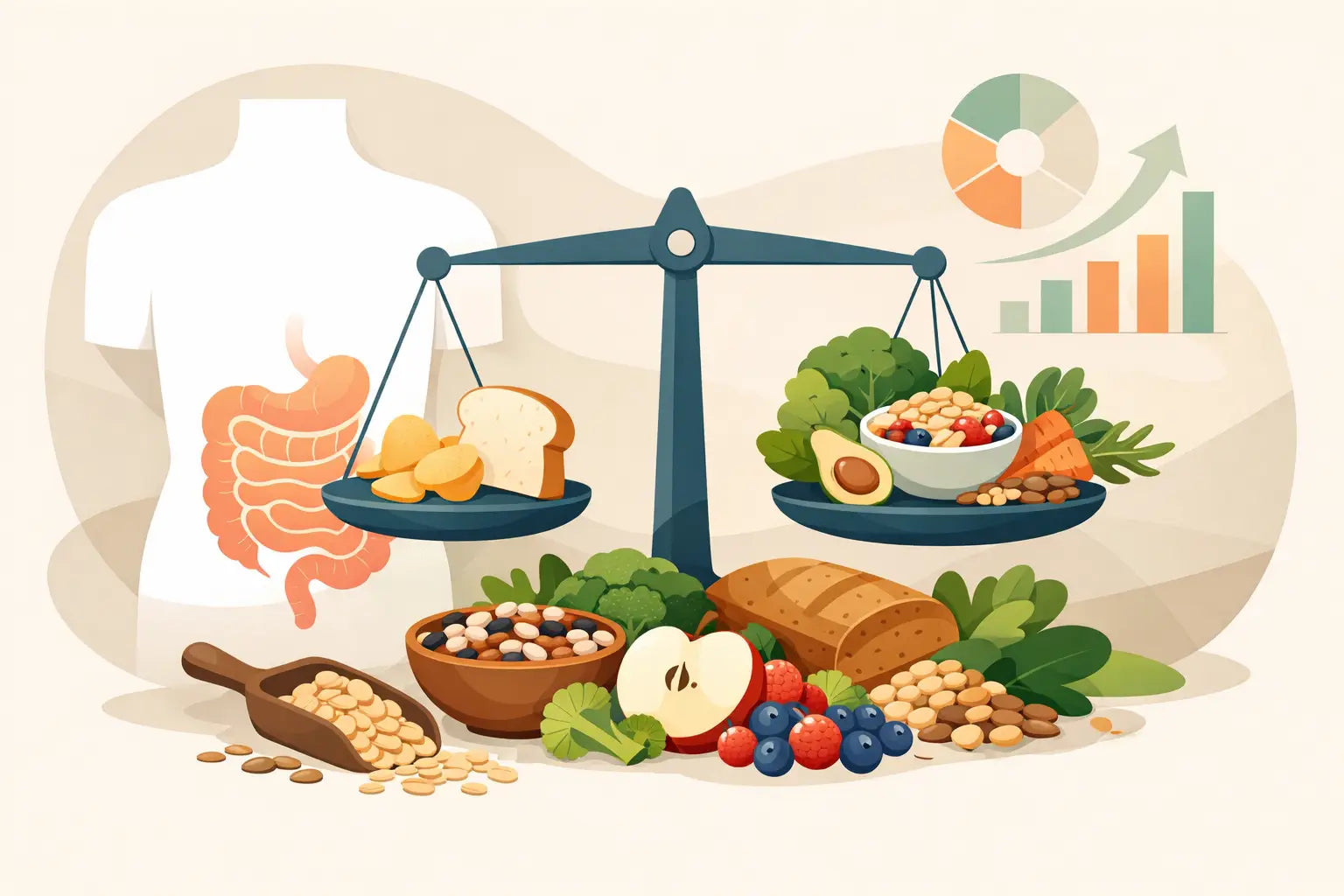
Bloating after eating, afternoon cravings, sluggish digestion despite "actually quite good" nutrition – this is exactly where the topic of gut health and the microbiome suddenly becomes very concrete. Because your gut doesn't work silently in the background. It influences how you process food, how full you feel, and often how stable your energy level remains throughout the day.
Many still only associate gut health with digestion. This is too limited. The gut houses a complex ecosystem of microorganisms that interacts with your diet, lifestyle, and even your routine. When this system is well-nourished, many things run more smoothly, more stably, and often more pleasantly.
What is meant by gut health and the microbiome
The microbiome describes the totality of microorganisms that live on and in your body – the gut microbiome is particularly relevant here. This mainly refers to bacteria that live in the large intestine and influence metabolic processes there. They help process food components, form metabolic products, and are in close exchange with the intestinal lining.
Gut health is somewhat broader. It includes not only the composition of the microbiome but also how well your digestion works, how stable the gut barrier is, and how your gut reacts to diet, stress, or medication. A "healthy" microbiome is therefore not a rigid ideal state. It's more about balance, diversity, and your gut being able to function well under everyday conditions.
It is also important to note: more bacterial species are not automatically always better, and individual superfoods rarely solve everything. The gut reacts primarily to patterns. What you eat regularly, how you sleep, how much you move, and how consistent your habits are usually makes more of a difference than individual health trends.
Why the microbiome depends on fiber
When talking about gut health and the microbiome, there's no getting around fiber. The reason is simple: certain fibers serve as food for beneficial gut bacteria. Especially soluble and fermentable fibers are metabolized by bacteria in the large intestine. This produces short-chain fatty acids like butyrate, acetate, and propionate.
These metabolic products are anything but secondary. They support the intestinal lining, influence the gut environment, and are linked to various health effects. This is precisely why adequate fiber intake is not a minor matter for people who want to actively support their digestion.
The problem: many adults don't reach the recommended amounts in everyday life. Not out of ignorance, but because modern nutrition is often convenient, protein-focused, and low in fiber. If you only drink coffee in the morning, eat something quick on the go at lunchtime, and opt for simple options in the evening when exhausted, you quickly fall short despite a healthy ambition.
This highlights an important difference between theory and reality. Yes, fiber is found in whole grains, legumes, nuts, vegetables, and fruits. But whether these foods end up on the plate daily in sufficient quantities and are well-tolerated is another question. Gut health doesn't improve through good intentions, but through consistent nourishment.
What tends to harm your gut in everyday life
The gut is adaptable, but not infinitely resilient. A diet that is consistently low in fiber and rich in highly processed products is particularly unfavorable. If the microbiome regularly lacks fermentable food, its activity will change over time.
Added to this is stress. It doesn't directly change your entire microbiome overnight, but it can exacerbate digestive problems, affect gut motility, and make sensitive people acutely aware of how closely the gut and nervous system work together. Lack of sleep, little exercise, and frequently changing meal times also play a role.
Antibiotics can also temporarily alter the microbiome significantly. This does not mean that they should generally be avoided – they are often medically necessary. But it shows that the gut is not an isolated construction site. It reacts to the overall setting of your lifestyle.
How to tell if your routine isn't suitable for your gut
Not every stomach rumble is a warning sign. Nevertheless, there are typical indications that your gut might need more support in everyday life. These include sluggish or irregular digestion, frequent feelings of fullness, strong fluctuations in satiety, or the feeling that certain meals always "sit heavy."
Again, symptoms are not always solely related to fiber or the microbiome. Intolerances, diseases, or other medical causes should be clarified by a doctor in the case of persistent complaints. This is precisely why an evidence-based view is so important. Gut health is not an esoteric topic, but an area where simple measures can achieve a lot – but not every complaint is solved with a powder or a trendy diet.
How to realistically support your microbiome
The most effective strategy is usually surprisingly unspectacular: more fiber, more regularity, fewer extremes. What is consistently achievable is crucial.
1. Increase fiber slowly and steadily
If you have previously eaten a low-fiber diet, more is not automatically better immediately. Too rapid an increase can worsen bloating or feelings of pressure. A gradual build-up is more sensible so that your gut can adapt. Consistency beats intensity.
2. Eat variety, but don't overcomplicate it
Different plants provide different types of fiber. This is good for the microbiome. But you don't have to build a perfect diet plan for that. Even a wider range of vegetables, oats, flaxseeds, legumes, berries, or whole grains makes a difference if they are consumed regularly.
3. Drink enough
Fiber needs fluids, especially if you increase your intake. Otherwise, you'll feel the opposite of what you actually want to achieve. Water alone is not a miracle cure, but in combination with fiber, it is a practical lever.
4. Use routines instead of motivation
The gut benefits from regularity. Fixed mealtimes, a recurring breakfast, a fiber boost in a smoothie or yogurt – such rituals work better in real life than short-term phases of perfection. That's why simple, taste-neutral solutions are often more helpful than complicated health plans.
Food, supplements, and the question: What makes sense?
Ideally, a large part of the fiber comes from food. That remains the basis. At the same time, it is realistic to acknowledge that everyday life doesn't always run ideally. Between meetings, commuting, sports, and social life, a gap quickly arises, even though there is health awareness.
Then functional supplements can be useful – not as a substitute for nutrition, but as pragmatic support. The quality of the composition is crucial. Not every fiber works the same, not every mixture is equally well tolerated, and not every solution fits into a daily routine.
Especially with sensitive digestion, everyday applicability is key. Taste-neutral, easily integrable fiber blends have a clear advantage because they are not experienced as an additional hurdle. If a product fits into coffee, water, yogurt, or meals, the chance that it actually becomes a routine increases. And that's often where the real benefit arises.
Innerpure addresses precisely this supply gap: scientifically sound, uncomplicated in everyday life, and with a clear focus on a daily fiber routine instead of short-term effects.
What you shouldn't expect
A common misconception: if you improve your gut health today, you should feel everything tomorrow. That rarely works. The microbiome reacts to nutrition, but it's not a light switch. Some people notice changes in digestion and satiety relatively quickly, others take longer.
Even more fiber doesn't automatically mean completely symptom-free digestion. It depends on the initial situation, on tolerability, on stress, sleep, and on how consistently the measure is implemented. Anyone with severe or persistent complaints should not only rely on self-optimization but should seek medical clarification of what is behind them.
Gut health and the microbiome are an everyday topic
Perhaps the most important point is not a spectacular one: your gut benefits not from perfection, but from nourishment. Not once, but daily. Anyone who wants to support their microbiome usually doesn't need an extreme diet or a complicated biohacking plan. Much more effective is a routine that reliably covers fiber, is well tolerated, and seamlessly integrates into one's everyday life.
That's where health knowledge makes a real difference. Not when you do everything right, but when you do the right things regularly.