The difference between a breakfast that sustains you until noon and one that has you reaching for snacks by 10:30 AM often isn't about calories, but fiber. This is precisely why the question of the best fiber sources for breakfast is so relevant: Those who don't get enough in the morning often start the day with an avoidable nutritional gap.
Fiber doesn't work spectacularly, but it does work reliably. It supports normal digestion, promotes satiety, and helps to reduce the sharp rise in blood sugar after eating. The German Nutrition Society recommends 30 grams of fiber per day. Many adults consume significantly less. Breakfast is therefore not a side issue, but a strategic moment to increase daily intake smartly and without extra effort.
Why the Best Fiber Sources for Breakfast Make Such a Difference
In the morning, many people eat either very quickly or very sweet. A croissant on the go, toast with jam, or yogurt with some crunch taste good, but often provide little fiber. The result is familiar to almost everyone: first a short energy boost, then a dip in concentration, cravings, or the feeling of never being truly full.
The best fiber sources for breakfast work differently. Soluble fibers, in particular, can bind water, swell in the intestine, and thus contribute to longer satiety. At the same time, certain fibers serve as food for gut bacteria. This makes them interesting not only for digestion but also for an overall stable routine concerning energy, well-being, and eating behavior.
However, it's also important to consider practical aspects: Not every theoretically fiber-rich food fits into every morning. Someone who is already on a call at 7 AM needs something different from someone who eats breakfast at leisure. The best source is therefore not only nutrient-rich but also realistically integrable into your daily life.
Best Fiber Sources for Everyday Breakfast
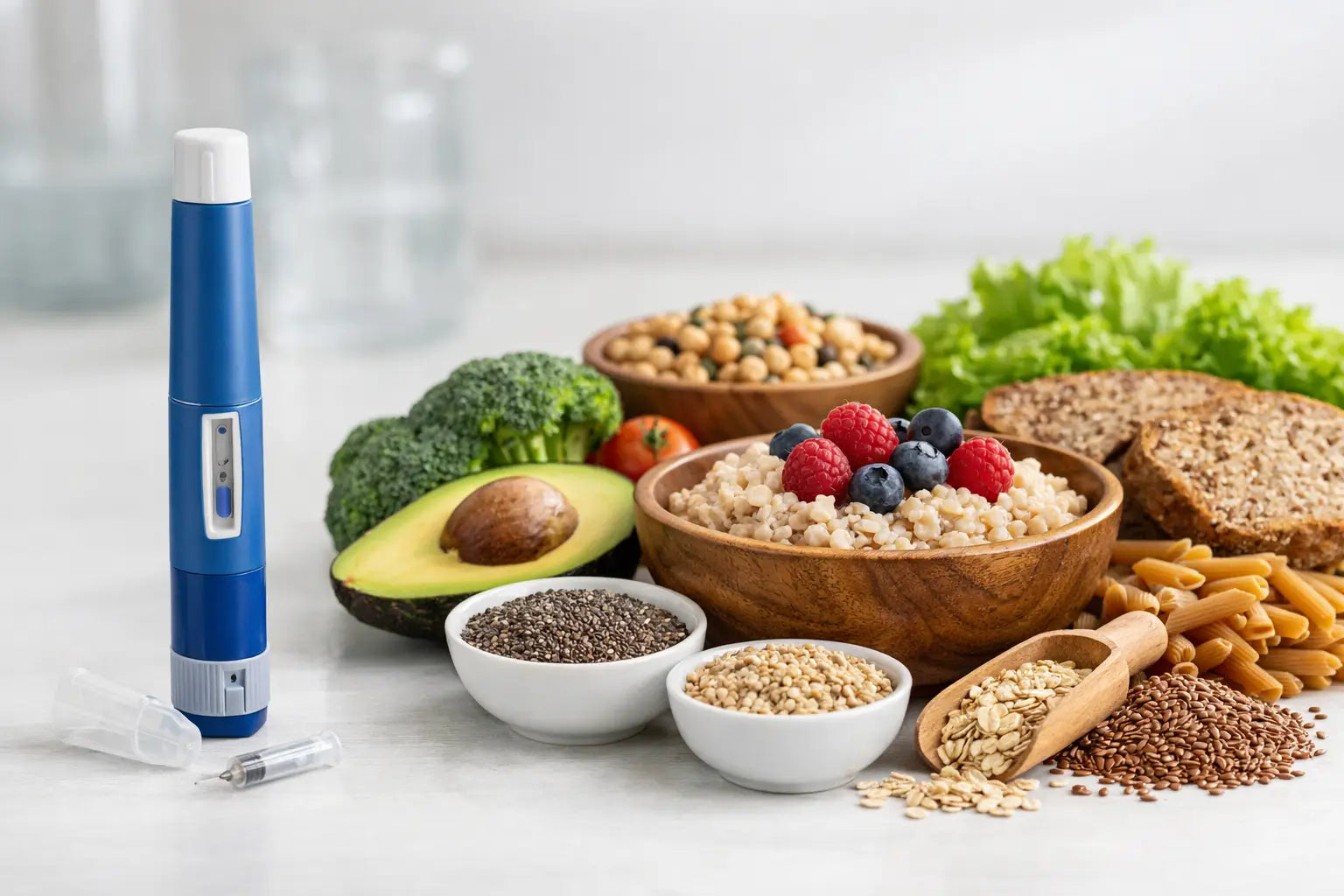
Oats are high on the list for good reason. They provide fiber, are versatile, and can be eaten both warm and cold. Their content of beta-glucans, which can contribute to longer satiety, is particularly interesting. A porridge with oats, chia seeds, and berries is therefore much more than a wellness cliché—it's a functional meal with a solid fiber base.
Chia seeds and flaxseeds are small but nutritionally quite efficient. Just one to two tablespoons in yogurt, porridge, or a smoothie noticeably increase the fiber content. Flaxseeds also have the advantage that they can be very easily incorporated into savory or sweet breakfasts. Crushed, they are usually more practical than whole seeds because they can be utilized better.
Berries are one of the easiest ways to enhance a breakfast. Raspberries, blackberries, and blueberries provide a pleasing amount of fiber compared to many other fruits. At the same time, they are practical for everyday use because they require little preparation. Frozen, they work just as well as fresh.
Whole-grain bread can also be a strong choice if it is truly a whole-grain bread with a high whole-grain content. Nutritionally, there are worlds between fluffy multi-grain rolls and real whole-grain bread. Combined with avocado, hummus, or nut butter, it becomes a breakfast that satisfies longer than classic toast.
Legumes for breakfast may seem unusual to many at first, but they are extremely useful in savory routines. A savory breakfast with chickpea spread, beans on whole-grain toast, or a small lentil salad is rich in fiber, stabilizing, and often surprisingly well-tolerated—especially if the gut is slowly accustomed to it.
Nuts and seeds are not the main source, but a useful enhancer. Almonds, walnuts, pumpkin seeds, or sunflower seeds supplement breakfasts with fiber, fats, and texture. They don't replace a base like oats or whole grains, but they usually make a good breakfast more complete.
What Often Looks Healthy But Provides Little Fiber
Especially in supermarkets, healthy breakfast is often just well-packaged marketing. Fruit yogurt, granola mixes, breakfast bars, or smoothies seem conscious and balanced, but do not automatically contain relevant amounts of fiber. Often, sugar, syrups, or finely processed ingredients dominate, while the fiber content remains negligible.
Juices are another typical example. Fruit sounds healthy, but a large part of the fiber is lost during juicing. A whole apple is a different category in this regard than a glass of apple juice. This does not mean that juice is forbidden—only that it should not be planned as a fiber source.
For breakfast cereals, a sober look at the nutritional values is worthwhile. A lot of crunch rarely means a lot of fiber. If "whole grain" is on the package, that's a good start, but no proof of a truly high fiber content.
How to Incorporate More Fiber in the Morning Without Reinventing Your Breakfast
The most common mistake is thinking too big. For more fiber, you don't immediately need meal prep in jars, exotic ingredients, or a perfect morning ritual. Often, a few small adjustments that add up are enough.
If you currently eat toast for breakfast, switching to real whole-grain bread is already a sensible step. If you like yogurt, oats, berries, and a spoon of flaxseeds will make it a much more functional breakfast. If you have little appetite in the morning, a drink or a bowl with supplementary fiber can be more practical than a large breakfast.
Regularity is crucial. The gut benefits more from a constant daily intake than from occasional health days. That's why simple rituals work so well. A flavorless fiber supplement that fits into coffee, water, yogurt, or overnight oats can be a very pragmatic solution—especially for people who care about their diet but don't want to cook fresh every morning. Brands like Innerpure focus precisely on this everyday suitability: fiber not as a complicated health topic, but as a fixed, easy-to-implement routine.
How Much Fiber-Rich Breakfast Is Sensible?
A good breakfast doesn't have to provide the entire 30 grams for the day. A realistic and sensible amount is often 8 to 15 grams, depending on the rest of your diet. This is enough to make a strong contribution in the morning without overwhelming the stomach.
Anyone who has previously eaten very little fiber should not go from zero to maximum. An abrupt increase can lead to bloating or a feeling of fullness. It is better to gradually increase the amount and drink enough at the same time. Fiber needs liquid to fully develop its positive effects.
Tolerability is also individual. Some do very well with oats and flaxseeds, others react more sensitively to large amounts of raw food or legumes in the morning. Therefore, here too: scientifically sound is important, but practical and well-tolerated is crucial.
Three Breakfast Models That Really Work
The first model is the quick bowl. Natural yogurt or a plant-based alternative, plus oats, berries, flaxseeds, and a few nuts. This takes two minutes, is significantly more satiating than sweet convenience products, and can be made without cooking.
The second model is the warm breakfast. Porridge made from oats, supplemented with chia seeds, apple pieces or pear, and some nut butter. Especially for people with sensitive digestion, warm breakfast is often more pleasant than cold, raw variants.
The third model is savory. Whole-grain bread with hummus, avocado and seeds, or an egg if it fits the diet. If you prefer salty to sweet in the morning, you don't have to compromise on fiber—quite the opposite.
What Really Matters in the End
The best choice is not the theoretically most perfect food, but the breakfast you actually eat on a busy Tuesday morning. Fiber-rich, uncomplicated, and regular beats ambitious but impractical.
If you build your breakfast in such a way that it provides a real foundation for digestion, satiety, and stable energy, often more than just the morning changes. Sometimes better nutrition begins not with deprivation, but simply with a spoonful more of what noticeably benefits your everyday life.