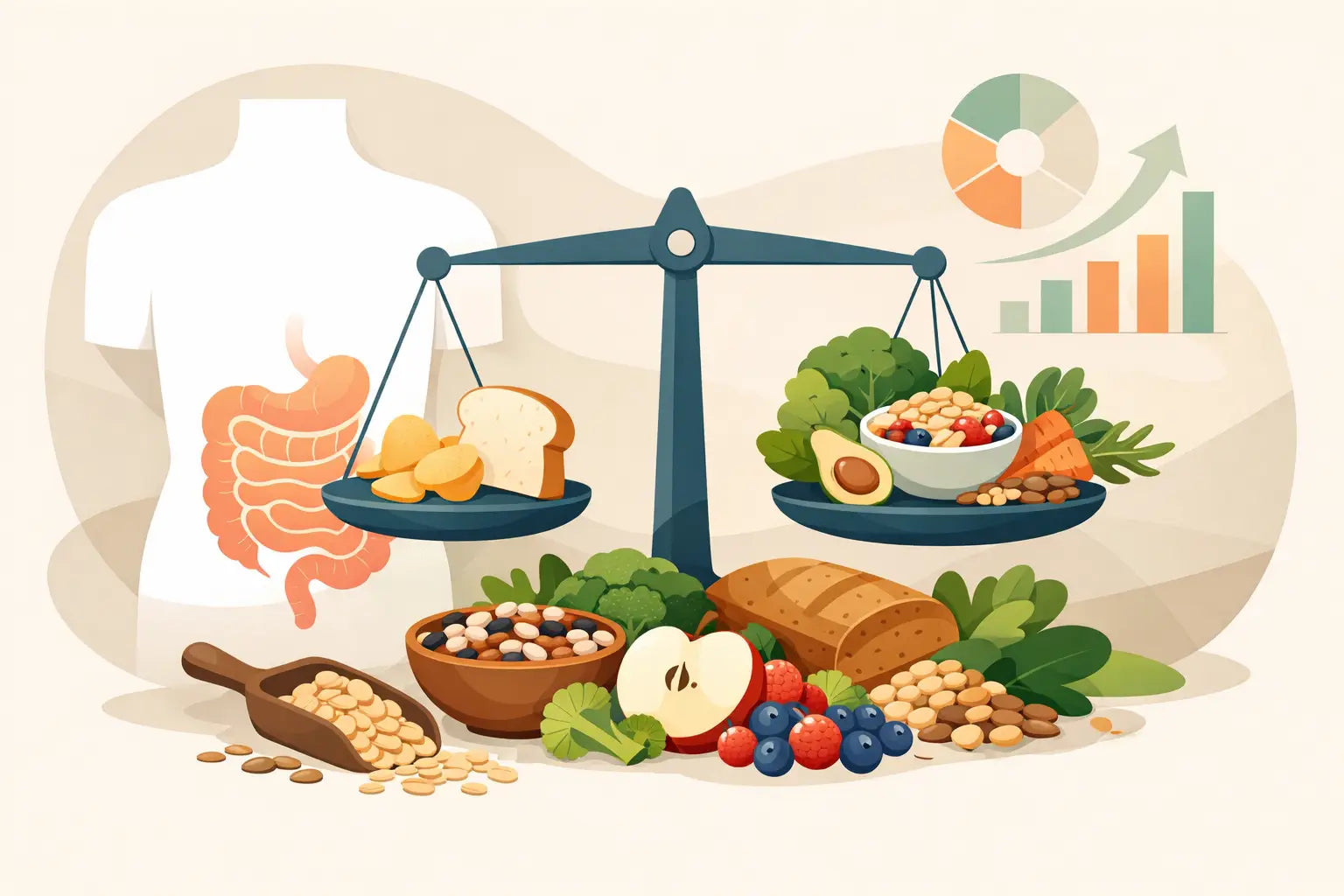
3:30 PM, two calls left, and suddenly the chocolate bar in the office or the delivery app on your phone seems remarkably convincing. Cravings rarely feel like a conscious decision. This is precisely why fiber against cravings is so relevant: It doesn't start with willpower, but much earlier – with satiety, blood sugar regulation, and eating rhythm.
Why Cravings Are Often Not a Character Issue
Many treat cravings as a discipline problem. In practice, however, it is often a biological signal. If meals are digested very quickly, blood sugar rises sharply and then drops rapidly again, the body often signals a need for energy again early. The result is well-known: You feel hungry again shortly after eating, even though the calorie intake should have been sufficient.
Added to this is modern everyday life. Breakfast is skipped, lunch is something quick, and the afternoon brings a slump. If you've eaten little protein, little volume, and especially too little fiber, you'll not only get hungry, but often crave sweets or very salty, highly processed snacks. This is no coincidence, but a mixture of physiology, habit, and context.
How Fiber Helps Combat Cravings
Fiber itself provides little to no usable energy, but it can do an enormous amount for satiety. Especially soluble fiber binds water, swells in the gastrointestinal tract, and slows down gastric emptying. Simply put: Food stays "occupying" the body longer instead of passing through very quickly.
This is the first lever. When nutrients are absorbed more slowly, blood sugar usually runs more evenly. This can help cushion strong highs and lows – and thus also the typical moments when cravings become particularly loud.
A second point is the hormonal aspect of satiety. Fiber-rich meals are associated with a stronger and longer-lasting feeling of fullness. This does not mean that fiber neutralizes every snack craving. Emotional eating, lack of sleep, or stress also play a role. But those who increase their daily fiber intake often improve the basis on which appetite is regulated at all.
Not all fiber feels the same
Different types of fiber are found in foods, and there are also different forms in supplements. Soluble fiber is often particularly valued when it comes to satiety, blood sugar management, and everyday usability. Insoluble fiber is also important, especially for stool volume and digestion, but does not always produce the same "calm" satiety effect.
Therefore, the question is not only whether you eat fiber, but also which ones and how regularly. A large salad in the evening does not compensate for an entire day of very low-fiber meals.
How to Recognize a Lack of Fiber in Your Daily Life
The German Nutrition Society recommends that adults consume 30 grams of fiber per day. Many people fall noticeably short of this. This is not always immediately noticeable in digestion. More often, it shows up indirectly: quick hunger after breakfast, heavy snacking in the afternoon, little satiety despite sufficient portions, or the feeling of "not being able to get through" without something sweet.
Typical convenience meals, in particular, make it easy to fall into a fiber gap. A croissant to go, pasta without vegetables, protein bars instead of a proper meal – all of these can be practical, but often keep you full for a shorter time than you think. Those who sit a lot, work a lot, and eat on the side often only notice the lack of satiety when cravings have already set in.
Fiber against Cravings in Real Everyday Life
The good news is: you don't have to completely reinvent your diet. The key is to treat fiber not as an afterthought, but as an integral part of your daily routine. That makes a difference.
A breakfast of coffee and something quick often provides too little substance for a stable morning. If, instead, oats, chia seeds, berries, or yogurt with a fiber-rich supplement come into play, satiety often shifts significantly. Similarly at lunch: a bowl with legumes, whole grains, and vegetables usually lasts differently than a white flour snack with little volume.
Fiber works best not as a punctual rescue, but distributed throughout the day. The body usually reacts more reliably to constancy than to extremes. If you consume almost no fiber in the morning and at noon, you will not automatically eat more balanced in the evening.
Practical over Perfect
Not everyone cooks fresh meals daily, and not every meal needs to be nutritionally ideal. The crucial factor is how easily a better intake can be integrated into your rhythm. For many, this works through clear standards: oats instead of sugary cereals, whole grains instead of white flour, regular legumes, more fruits and vegetables with texture – and where it makes sense, a tasteless fiber supplement that fits into drinks or meals.
This is precisely where routine becomes more important than motivation. If fiber only appears when you're "eating particularly healthy," it often provides too little help in everyday life.
What fiber cannot achieve
As helpful as fiber against cravings is – it's not a magic trick. If you chronically sleep too little, are very stressed, or constantly skip meals, even a good fiber intake can only partially curb cravings. Also, high-calorie snacks do not automatically lose their appeal just because a breakfast was richer in fiber.
Dosage is also important. Those who abruptly increase their intake significantly may experience bloating or a feeling of fullness. A gradual build-up, accompanied by sufficient fluid, is better. Fiber needs water to function properly.
For certain conditions, such as chronic gastrointestinal diseases or very sensitive digestion, it also depends on the type and amount. More is not always better. In such cases, it is worthwhile to individually examine which sources are well tolerated.
The Combination Makes the Difference
Fiber works best when the rest of the meal is supportive. Stable satiety often arises from the interplay of fiber, protein, fluids, and a sensible portion size. A fruit juice with added fiber provides different satiety than a complete breakfast with Skyr, oats, and nuts. Both can have their place, but expectations should remain realistic.
Therefore, if you want to specifically reduce cravings, you shouldn't just look at grams. The better question is: Does my meal truly keep me full for the next three to four hours? If not, it's rarely due to a single factor.
How to Build a Fiber Routine
The easiest start is often to define one meal that works daily. For example, a breakfast that reliably contains fiber and doesn't require much effort. Once a routine is established, the effect is usually greater than with constantly changing "healthy phases."
If you also supplement, the solution should primarily be suitable for everyday life. Tasteless, uncomplicated, and without much preparation effort – because what is only theoretically healthy rarely becomes a habit in practice. Innerpure addresses precisely this supply gap: a simple daily fiber routine that can be discreetly integrated into drinks and meals.
Nevertheless, food remains the foundation. Whole grains, legumes, vegetables, fruits, nuts, and seeds offer additional benefits beyond fiber that a supplement cannot completely replace. The most sensible approach is usually a combination of better food choices and a solution that reliably closes gaps in everyday life.
When are the first effects noticeable?
Many expect cravings to disappear after two fiber-rich meals. It rarely works that way. Some notice after just a few days that they stay full longer. For others, it takes one to two weeks for digestion, eating rhythm, and satiety to noticeably stabilize. This depends on how large the previous gap was and how consistently the change is implemented.
It helps not to just look at the scale or calories, but at signals throughout the day: Do you think less about snacking between meals? Does your energy remain more consistent? Do you find it easier to stop at a normal portion? This is often where you first see if your fiber strategy is working.
Cravings are rarely a sign that you just need to pull yourself together more. Often, they are an indication that your daily life needs more structure, more satiety, and a better foundation. When fiber becomes a fixed ritual instead of an occasional health topic, eating often feels noticeably calmer – and that usually feels better in everyday life than any short-term willpower.