The morning rarely decides everything – but it often determines whether good intentions still have a chance later in the day. If you're trying to build a fiber routine in the morning, you're not starting with a complicated dietary rule, but with a reliable anchor: a breakfast or drink that can be implemented even between your calendar, commute, and to-do list.
This is relevant because many people eat significantly less fiber than recommended in their daily lives. The German Nutrition Society recommends at least 30 grams daily for adults. A supply gap easily arises between quickly consumed coffee, white bread, and meals on the go. A consciously designed morning can help close this gap step by step – without deprivation and without feeling like you have to overturn your entire daily plan.
Why a morning fiber routine works so well
Fiber consists of plant-based food components that are not digested or only partially digested in the small intestine. They serve various functions: some swell with liquid, others are fermented by bacteria in the large intestine and serve as food for the microbiome. Both properties make them a valuable part of a balanced diet.
In the morning, the hurdle is particularly low. Many habits are already firmly established: the first glass of water, coffee, breakfast, the smoothie before exercise, or yogurt at your desk. Instead of planning an additional task, you are supplementing something that is already happening. This is precisely what turns it into a routine that endures in the long term.
In addition, there's the practical effect: a high-fiber breakfast can make the meal more filling and help stabilize your morning. This doesn't mean that fiber alone solves cravings or fatigue. Sleep, stress, exercise, and the overall composition of your diet also play a role. But as a daily basic building block, they are surprisingly effective – precisely because they are so easy to integrate.
Building your morning fiber routine – not radically, but regularly
The most common mistake is too big a leap. Those who switch directly from a very low-fiber diet to large amounts of legumes, bran, and seeds may react with bloating, a feeling of fullness, or an upset stomach. This is not a sign that fiber is fundamentally unsuitable. The gut often needs time to adapt to more fermentable substrates and a higher volume.
Therefore, start with a small, clear change and stick with it for several days. Perhaps you'll first add only oats, berries, or a spoonful of seeds to your usual breakfast. Or you can stir a flavorless fiber mix into your coffee, smoothie, or yogurt. Only when that feels good should you increase the amount or add more sources throughout the day.
Regularity is more important than perfection. A very high-fiber Sunday breakfast doesn't compensate for a week where mornings were rushed. A small portion on five weekdays is usually more valuable for a stable habit than an ambitious fresh start that ends after three days.
The right starting point: What do you already eat or drink?
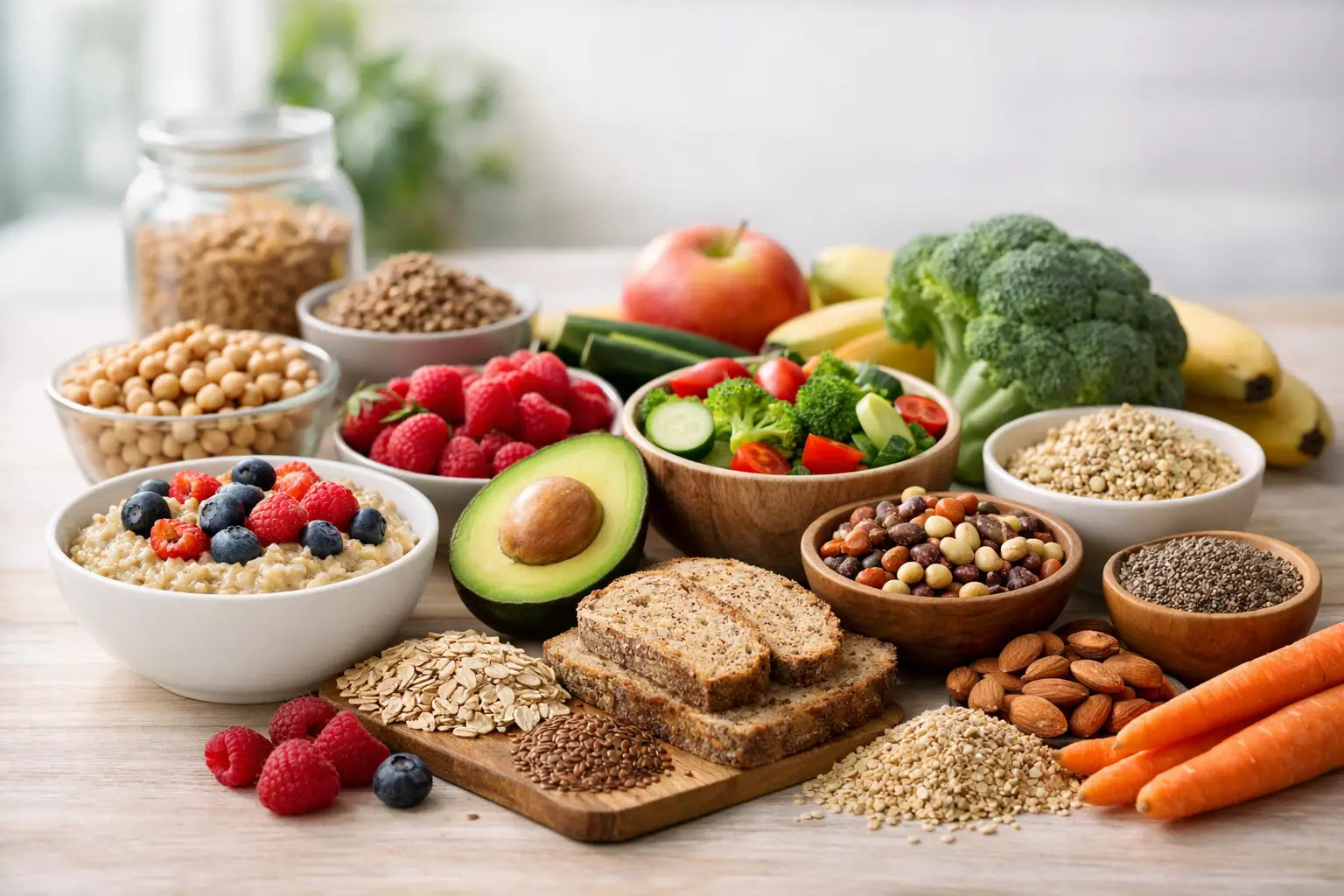
The best routine adapts to your life. If you enjoy breakfast in the morning, a bowl of natural yogurt or a plant-based alternative with oats, fruit, and nuts can be a good base. If you like it warm, combine porridge with apple, pear, or berries. If you prefer savory foods, whole-grain bread, hummus, vegetables, and a piece of fruit already provide several sources of fiber.
For people who have little appetite in the morning, a drink is often more realistic. A smoothie with berries, oats, and nut butter works well. Even simpler is a glass of water, coffee, or tea with a completely soluble, flavorless fiber source. What matters is not which format is theoretically ideal. What matters is which one you will actually use on a Tuesday morning when you only have ten minutes.
Fluid is an essential part of it
Fiber and fluid are a team. Swelling fibers, in particular, require enough water so that they can comfortably support their passage through the digestive tract. Therefore, it's worth linking your morning routine with a large glass of water – regardless of whether coffee, tea, or breakfast follows.
How much fluid is individually appropriate depends, among other things, on body size, activity, temperature, and diet. A practical rule of thumb is: drink regularly throughout the day and also be guided by your thirst. A single glass in the morning does not replace sufficient fluid intake until the evening.
Three breakfast formats that work in everyday life
You don't need new recipes for every day of the week. Two or three reliable variations that you can rotate are better. This keeps your diet varied without unnecessary planning.
The quick bowl: Natural yogurt, Skyr, or a plant-based alternative with oats, berries, and nuts or seeds. This combination brings together various plant-based components and can be prepared the evening before. If desired, add a soluble fiber mix that can be subtly stirred in.
The warm classic: Porridge made from oats, combined with fruit, nut butter, and cinnamon. Particularly practical on cool days or when you need something filling. Make sure to choose a portion that suits your hunger and your daily schedule.
The minimal drink: A smoothie or your usual morning drink with a flavorless fiber source. This is not a second-rate solution, but a smart option for days when an elaborate breakfast is simply not realistic. At Innerpure, exactly this uncomplicated application is part of the concept: fiber should fit into everyday life, not create additional planning stress.
Variety counts more than a single superfood
Chia seeds, flaxseeds, or psyllium husks can be useful additions. However, they are not the only answer to the fiber gap. Different fibers have different properties, and the microbiome also benefits more from plant diversity than from a single source in high quantities.
Therefore, think in terms of building blocks: whole grains, fruits, vegetables, legumes, nuts, seeds, and soluble fiber sources complement each other. Breakfast provides the initial impulse, while lunch and dinner carry the rest of the day. Combining a whole grain product or oats, fruit, and a fiber source in the morning lays a good foundation – even if the goal of 30 grams doesn't have to be achieved solely at breakfast.
Another point: not everyone tolerates every source equally well. For a sensitive gut, large amounts of onions, legumes, or certain fermentable carbohydrates can exacerbate symptoms. In such cases, smaller portions, a slower increase, or other fiber sources are often more sensible. For persistent symptoms, chronic bowel diseases, or a diet prescribed by a doctor, the adjustment should be individually medically or nutritionally supervised.
How to turn a good idea into a firm ritual
Habits rarely arise from motivation alone. They arise from a clear trigger and as little friction as possible. Lay out your ingredients visibly, set out your glass the night before, or place your fiber mix next to the coffee maker and kettle. The fewer decisions needed in the morning, the more likely the routine will stick.
An "if-then" rule is also helpful: If the coffee machine is running, I'll drink my water and prepare my fiber drink. When I take my yogurt out of the fridge, I'll add oats and fruit. Such firm connections turn an intention into repeatable behavior.
Also, plan for a backup option. Perhaps your standard routine is a bowl at home, while a portioned drink is ready for hectic days. A good routine doesn't have to look identical every morning. It just needs a version that works even when everyday life doesn't.
Your goal isn't a perfect breakfast or the most complicated health project possible. It's a morning ritual that reliably supports your fiber intake and feels good. Start small, give your gut time, and choose the option you'll still feel like doing tomorrow.